Be your Logistics Department in China
Customized logistics solutions, your logistics expert in China
Customized logistics solutions, Shipping from China to the World
Tel:+8613424475220 Email:info@viputrans.com 
 English

China to France business to business shipping service
Shipping from China to France for your business requires balancing three key factors: speed, cost, and regulatory compliance. Below is a breakdown of your main options and the current market landscape to help you make an informed decision.
Transport Mode | Transit Time | Best For |
Sea Freight | 40-48 days | Large volumes, non-urgent goods (machinery, furniture) |
Rail Freight | 18-25 days | A "middle-ground" option; faster than sea, cheaper than air (electronics, auto parts) |
Air Freight | 3-5 days | Urgent, high-value, or lightweight cargo (samples, fashion, tech) |
Truck Freight | 25-30 days | Large quantities of goods requiring flexible shipping |
Air freight from China to France is a well-established and efficient logistics corridor, driven by strong bilateral trade and a growing network of dedicated cargo services. The primary option is using scheduled all-cargo flights operated by major airlines, which offer a balance of speed, capacity, and reliability.
The following sections provide a detailed breakdown of the key aspects of air freight from China to France.
Direct cargo flights from China primarily land at Paris Charles de Gaulle Airport (CDG) , the nation's largest air cargo hub. From there, goods can be quickly distributed across France and Europe.
Route (Origin → Destination) | Airlines / Operators | Frequency | Approx. Flight Time | Total Door-to-Door Transit |
Shanghai Pudong (PVG) → Paris (CDG) | China Cargo Airlines | |||
Chengdu (TFU) → Paris (CDG) | China Cargo Airlines | Every Mon | ~11h (estimated) | |
Xi'an (XIY) → Paris (CDG) | Hainan Airlines | Every 1-2 weeks | ||
Other Major Hubs (PEK, CAN, SZX) | Various carriers (passenger/cargo combos) | Varies | ~11-13h | 3-7 days |
Air freight costs are volatile and depend on many variables, but the table below provides a general estimate for standard air freight.
Shipment Size (Weight) | Estimated Rate (USD/kg) | Typical Transit Time |
45-100 kg | $5.50 – $8.00 | 4-6 days |
100-300 kg | $4.80 – $7.00 | 4-5 days |
300-500 kg | $4.30 – $6.50 | 3-5 days |
500-1000+ kg | $4.00 – $6.00 | 3-5 days |
Express Courier | $9.00 – $13.00 | 2-4 days |
Note: Air freight is billed by chargeable weight, which is the greater of the shipment's actual weight or its volumetric (dimensional) weight (L x W x H cm / 6000)
Sea freight is the most common and economical method for shipping large volumes of goods from China to France. The journey primarily connects major Chinese ports with the French hub of Le Havre, with transit times typically ranging from 40 to 48 days for the ocean voyage
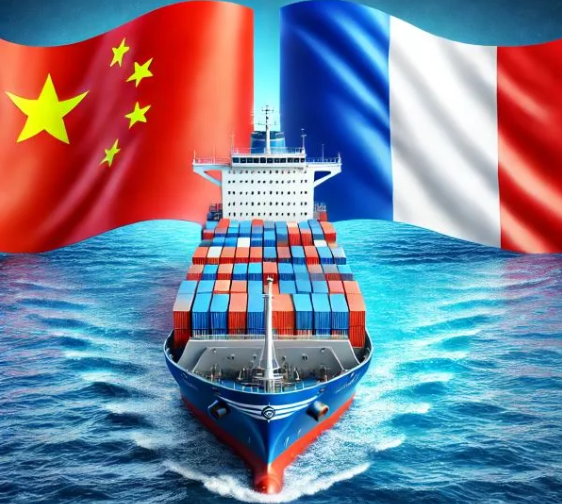
Major Chinese Export Ports:
Goods can depart from nearly any major industrial hub. The most common ports of loading (POL) are:
Ningbo-Zhoushan: A massive, modern port and a key partner for the France-China green shipping corridor .
Shanghai: One of the world's busiest ports, offering the highest frequency of sailings .
Shenzhen and Guangzhou (Nansha): Crucial hubs for southern China's manufacturing base .
Qingdao and Tianjin: Key ports in northern China .
Major French Import Ports:
Le Havre: By far the largest and most important container port in France. It handles a vast range of goods and is the primary gateway for containerized cargo from Asia. It is the main hub for the HAROPA port complex, which also includes Rouen and Paris, offering excellent river and rail connections inland .
Fos (Marseille): The leading French port for the Mediterranean basin. It is strategically important for shipments destined for southern France and connecting to markets in Southern Europe and North Africa .
Dunkirk & Brest: Other ports that handle specific cargo types or offer alternative routing options .
A Key Development: The HAROPA Port (Le Havre, Rouen, Paris) and China's Ningbo-Zhoushan Port have established a "green shipping corridor." This partnership aims to decarbonize maritime transport and improve efficiency on this vital trade lane
Many of the world's largest ocean carriers operate on the China-France route. VIPUTRANS will book space on vessels operated by companies including:
MSC (Mediterranean Shipping Company)
Maersk
CMA CGM (a major French global line)
Hapag-Lloyd, ONE, and Evergreen
Working with VIPUTRANS is standard practice. We act as an intermediary, consolidating your cargo, booking space on a vessel, and handling all the complex documentation and communication with these shipping lines
Rail freight from China to France offers a balanced logistics solution, positioned between the high cost of air freight and the long transit times of sea freight. It is an efficient and increasingly popular option for time-sensitive, mid-to-high-value goods.
This mode of transport is part of the extensive China-Europe Railway Express network, which now connects over 100 Chinese cities with more than 200 cities across 25 European countries. France is a key node in this network, with several major routes and dedicated terminals.
The primary rail corridor from China to France spans over 11,000-13,000 kilometers and typically follows this path: China → Kazakhstan → Russia → Belarus → Poland → Germany → France.
Below are the key railway stations and terminals in both countries, based on the search results.

Cargo Suitability: Rail freight is ideal for electronics, automotive parts, machinery, textiles, and e-commerce goods. It is generally not recommended for highly perishable items unless using specialized refrigerated containers, or for hazardous materials.
Service Options: You can ship via FCL (Full Container Load) for large volumes (typically 15+ CBM), which is more cost-effective per unit, or LCL (Less than Container Load) for smaller shipments (1-12 CBM), which costs more per CBM but allows you to share container space.
Documentation: Essential documents for customs clearance include the Commercial Invoice, Packing List, Rail Waybill (CIM/CIM) , and Certificate of Origin. An EORI number and correct HS/TARIC codes are mandatory for importing into France.
Tracking and Security: Most modern rail freight services, l equip trains with GPS technology, allowing for real-time online tracking of your cargo.
Truck freight from China to France, often referred to as "China-Europe Truck Freight" or "TIR Trucking," is a rapidly growing logistics solution that fills the gap between expensive air freight and slow sea freight. It offers a compelling balance of speed and cost, typically delivering goods in 18 to 25 days, which is approximately twice as fast as standard sea freight but at a fraction of the cost of air cargo.
This mode is particularly well-suited for time-sensitive goods such as automotive parts, electronics, e-commerce shipments, and machinery
Primary Truck Freight Routes
Unlike rail, which is constrained by fixed tracks, truck freight offers more flexible point-to-point connectivity. However, the journey still follows established international corridors. The most common route is the Northern Route, which uses the TIR (Transports Internationaux Routiers) system for streamlined customs clearance.
General Northern Route Sequence:
Origin (China): Pickup from supplier's warehouse in cities like Shenzhen, Yiwu, or Shanghai.
Exit Port (China): Departure from the Alashankou or Khorgos border crossing.
Transit Countries: The truck traverses Kazakhstan, Russia, and Belarus.
EU Entry Hub: Arrival at a major distribution hub, most commonly Małaszewicze, Poland.
Final Destination (France): Final road delivery to cities like Paris, Lyon, Lille, or Marseille
Key Operators and Service Features
Several logistics providers specialize in China-France truck freight, often leveraging the TIR Carnet system. This is a critical advantage, as it allows sealed trucks to cross multiple international borders with minimal inspections, drastically reducing delays.
Service Models: The primary model is FTL (Full Truck Load) , where a single client's goods occupy an entire truck for direct, non-stop service. Some providers also offer LCL (Less than Container Load) consolidation for smaller shipments.
Fleet and Cargo Capabilities: A key strength of truck freight is its ability to handle diverse cargo types using specialized vehicles.
Standard Tautliner/Curtain-sider: For palletized general cargo, machinery, and textiles.
Temperature-Controlled (Reefer): For pharmaceuticals, fresh produce, and other perishable goods requiring a stable environment.
Flatbed & Extendable Trailers: For oversized industrial equipment, construction materials, or goods exceeding standard dimensions
Key Advantages of Truck Freight
Flexibility: Provides direct service to inland destinations in France that lack rail sidings or are far from major seaports.
Speed: Consistently faster than standard sea freight, offering predictable 3-4 week transit times.
Security: TIR seal integrity and real-time GPS tracking reduce the risk of theft or damage.
Reduced Handling: "One truck, one driver" models minimize cargo handling, which is beneficial for fragile goods..
France Navigating French Regulations
The EU and France have updated import rules. A professional freight forwarder is essential to manage these:
ICS2 Security Filing: You must submit detailed data (HS code, precise description) before cargo is loaded, or it will be rejected.
VAT & IOSS: French VAT is 20%. For B2C sales under €150, use the IOSS system to charge VAT at checkout. For B2B, you can often use a VAT deferral scheme to improve cash flow.
EPR/Triman Label: Products with household packaging must display the "Triman" logo and sorting info physically on the package.
If you have any shipping need from China to France please feel free to contact us
Lora Yang E-mail: sales02@viputrans.com SKYPE|WECHAT|WHATSAPP|MOB:+86 13424468029
Copyright © 2003-2026 VIPU Supply Chain Logistics Co., Ltd. | All Rights Reserved
LOGISTICS | E-COMMERCIAL FULFILLMENT | ABOUT US | CASE | NEWS | VIDEO | CONTACT US
We will find the fastest or the cheapest way for your shipment. Please specify: where from, where to, what to ship.