Be your Logistics Department in China
Customized logistics solutions, your logistics expert in China
Customized logistics solutions, Shipping from China to the World
Tel:+8613424475220 Email:info@viputrans.com 
 English

FOB vs CIF: Which Shipping Term Is Better for International Trade?
In international trade, choosing the right shipping term is more than just a pricing decision — it directly affects transportation costs, cargo risk, customs coordination, and overall supply chain efficiency.
Among all international trade terms, **FOB (Free On Board)** and **CIF (Cost, Insurance and Freight)** are two of the most commonly used Incoterms in global logistics, especially in trade between China, Europe, Russia, the Middle East, and other international markets.
For importers and exporters, understanding the difference between FOB and CIF can help reduce unnecessary logistics risks and improve cost control.
What Is FOB?
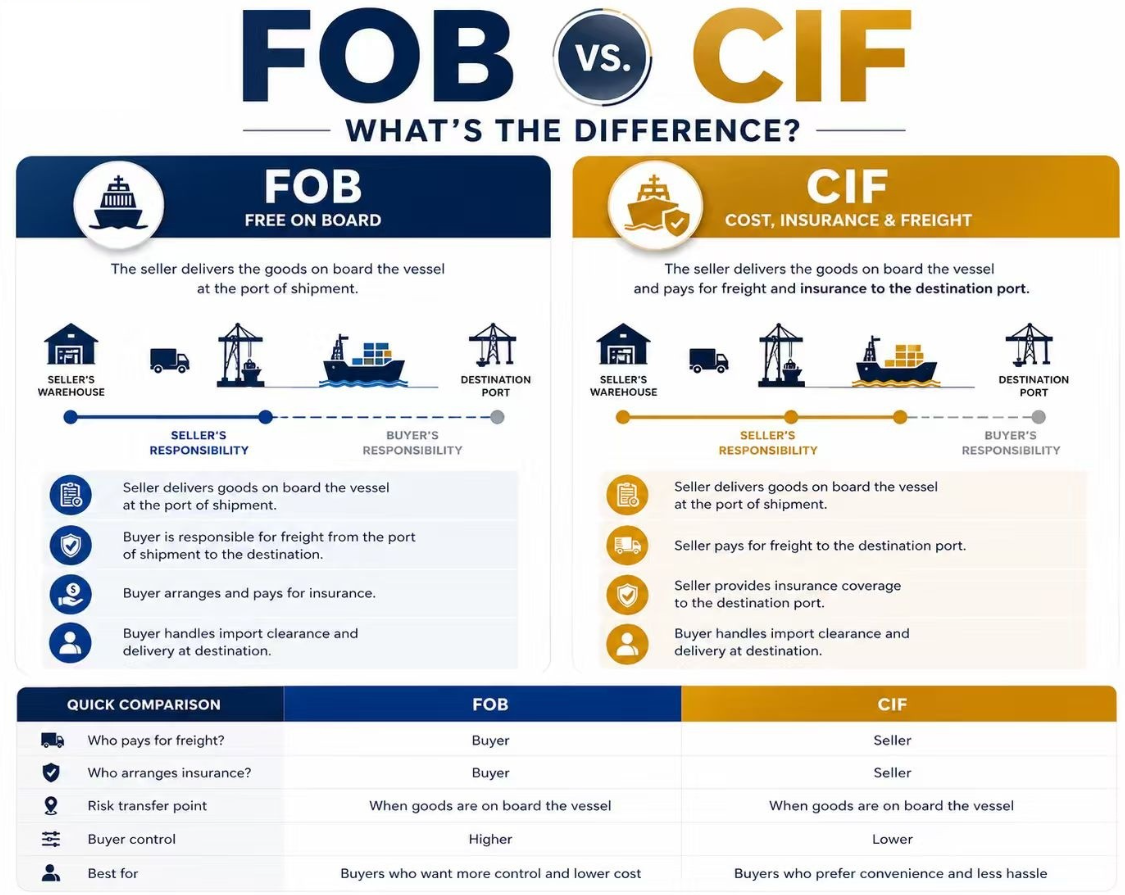
FOB (Free On Board) is a trade term where the seller is responsible for delivering the cargo to the designated port and loading it onto the vessel chosen by the buyer.
Once the goods are loaded on board, the responsibility and risk transfer from the seller to the buyer.
Under FOB Terms:
Seller Responsibilities :* Export customs clearance in China * Inland transportation to the port * Port handling charges * Loading cargo onto the vessel
Buyer Responsibilities :* Ocean freight * Cargo insurance * Import customs clearance * Destination port charges * Final delivery
FOB is widely used when buyers already have their own freight forwarders or logistics partners in China. It gives importers more control over shipping schedules, freight rates, and transportation management.
What Is CIF?
CIF (Cost, Insurance and Freight) means the seller is responsible not only for exporting and loading the goods, but also for arranging ocean freight and basic cargo insurance to the destination port.
Under CIF terms, the seller handles a larger portion of the transportation process.
Under CIF Terms:
Seller Responsibilities: * Export customs clearance * Inland transportation * Ocean freight arrangement * Basic cargo insurance * Delivery to destination port
Buyer Responsibilities: * Import customs clearance * Destination port fees * Final local delivery
CIF is often preferred by buyers who want a simpler purchasing process and do not have strong experience managing international logistics.
Main Differences Between FOB and CIF
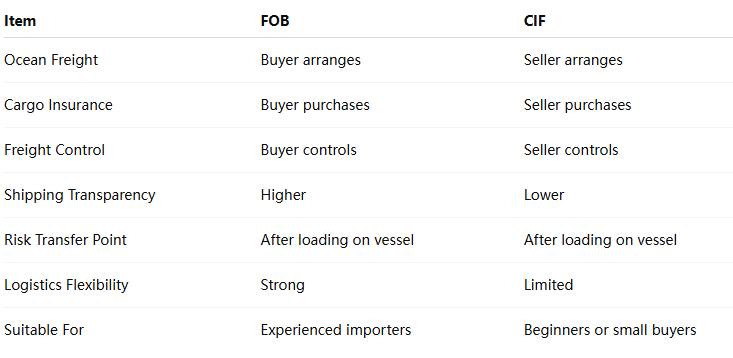
One important point many buyers misunderstand is that although the seller pays for freight under CIF, the cargo risk still transfers once the goods are loaded onto the vessel at the origin port.
This means buyers should still carefully review insurance coverage and shipping arrangements even under CIF terms.
FOB Advantages for Importers
Many professional importers in Europe and Russia prefer FOB shipments because it provides greater control over the supply chain.
Advantages Include:
l Better freight rate comparison
l More transparent shipping costs
l Flexible carrier selection
l Easier cargo tracking
l Ability to work with trusted freight forwarders
l Better control during peak shipping seasons
For example, during periods of unstable freight rates or port congestion, FOB buyers can quickly switch shipping lines or optimize transportation routes.
CIF Advantages for Buyers
CIF can still be a practical option for companies with limited logistics experience.
CIF Is Suitable When:
l The buyer is new to international trade
l Shipment volume is small
l The supplier offers competitive freight pricing
l Buyers want simplified operations
However, buyers should pay close attention to destination charges under CIF shipments. In some cases, low ocean freight costs may be offset by unexpectedly high local fees at the destination port.
Which Is Better: FOB or CIF?
There is no absolute answer because the best choice depends on the buyer’s logistics experience, shipment volume, and supply chain strategy.
FOB Is Better If:
* You have your own freight forwarder
* You want better cost control
* You import regularly
* You need flexible transportation solutions
CIF Is Better If:
* You are new to importing
* You prefer simplified shipping arrangements
* Your supplier provides reliable logistics support
In today’s global logistics environment, more international buyers are gradually shifting toward FOB terms because supply chain visibility and transportation flexibility have become increasingly important.
How Professional Freight Forwarders Can Help
Whether you choose FOB or CIF, working with an experienced international logistics partner is essential.
As a professional international freight forwarding company in China, VIPU SUPPLY CHAIN LOGISTICS CO., LTD provides comprehensive logistics solutions including:
Railway CL & LCL Shipping/Sea Freight/Air Freight/Customs Clearance/Warehouse Services/Door-to-Door Transportation.
For buyers in Europe, Russia, Central Asia, and the Middle East, choosing the right Incoterm together with a reliable logistics partner can significantly improve shipping efficiency and reduce transportation risks.
In a constantly changing global market, stable logistics solutions create long-term business value.
Welcome to your inquiries.Phone/WeChat/WhatsApp:+8618926970495;EM:sales04@viputrans.com; Shawn;
FOB and CIF are not simply pricing methods — they represent different levels of logistics responsibility, risk control, and supply chain management.
Before confirming any international order, importers should carefully evaluate:
l * Shipping costs
l * Cargo control requirements
l * Customs procedures
l * Insurance coverage
l * Long-term logistics strategy
Understanding these differences can help businesses make smarter purchasing decisions and build more stable international supply chains.
Copyright © 2003-2026 VIPU Supply Chain Logistics Co., Ltd. | All Rights Reserved
LOGISTICS | E-COMMERCIAL FULFILLMENT | ABOUT US | CASE | NEWS | VIDEO | CONTACT US
We will find the fastest or the cheapest way for your shipment. Please specify: where from, where to, what to ship.